
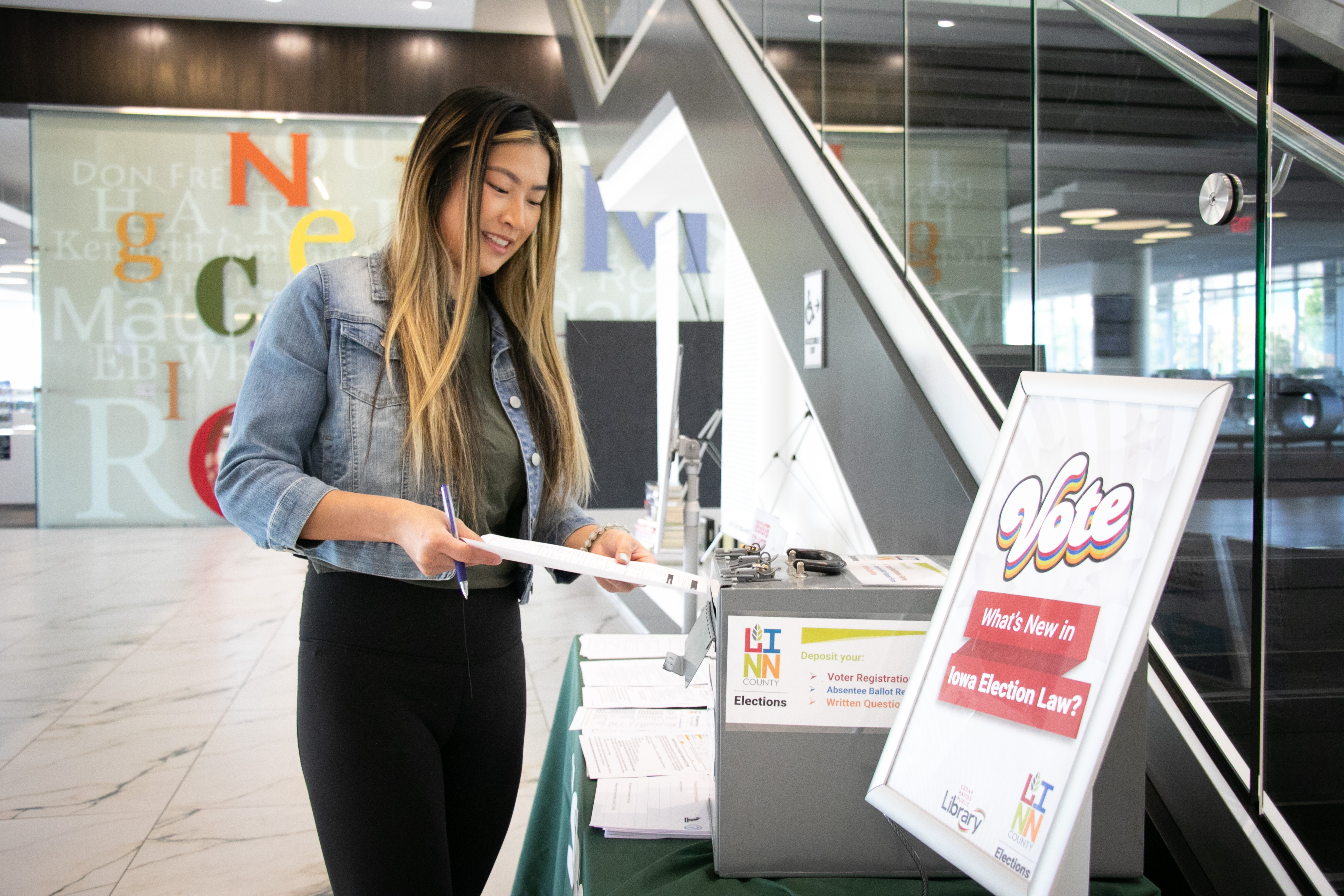
Upcoming Elections
June 2, 2026 Primary Elections
The Democratic and Republican political parties will vote to nominate candidates for the general election.
- Primaries are closed in Iowa, which means a voter will need to declare a party (Democratic or Republican) to participate.
- Voters will need to vote at their assigned polling place on Election Day. Click here to view a list of Linn County Polling Places (PDF).
- The pre-registration deadline for voter registration closes at 5 pm Monday, May 18. Voter registration forms (PDF) must be in the Linn County Election Services's office by that date.
- After the pre-registration deadline, anyone not yet registered in Linn County who wishes to vote – either absentee or at the polls – must go through the Election Day Registration process.
- Find a list of candidates in the primary here.
Absentee Voting:
- The deadline for requesting an absentee ballot is 5 p.m. Monday, May 18. Absentee ballot request forms (PDF) must be in the office by that date. Postmarks do not count!
- Early in-person absentee voting will begin on or after Wednesday, May 13 in the Auditor's Office at 935 Second St. SW, Cedar Rapids.
- Early in-person absentee voting will end at 4:30 pm on Monday, June 1.
- Voted absentee ballots must be returned by 8 pm to Election Services on Election Day for counting. Election Services is on the second floor of the Jean Oxley Public Service Center, 935 Second St. SW, Cedar Rapids.

Linn County Election Services
The Linn County Auditor’s office is at Linn County Elections Services, 935 Second St. SW, Cedar Rapids. They can be reached by phone at (319) 892-5300. Hours are 8 am-5 pm, Monday to Friday, except holidays. They have additional information and frequently asked questions on their website.
Cedar Rapids Public Libraries as Voting Precincts
The Downtown Library is Precinct 36 in 2026, and Ladd Library is Precinct 41.
Polling places are open on Election Day from 7 am-8 pm, including the library precincts. Regular library services will be available during our normal business hours, 9 am-8 pm.
Where do I vote? What's on my ballot? And how do I find my elected officials?
Linn County Election Services provides an online tool to help you find your precinct information, see sample ballots and see who your local elected officials are.

If you live outside Linn County or have additional questions about voting, visit the Iowa Secretary of State’s website.
Register to vote
In Iowa, you can register to vote or update your registration in four basic ways:
- Through the Iowa Department of Transportation when obtaining an Iowa driver license or nondriver ID.
- Download a registration form and send it through the mail to Linn County Election Services.
- In person at the Auditor's Office.
- Online through the Iowa Department of Transportation website.
If you are new to Linn County or miss the pre-registration deadline, it is still possible to register and vote on election day.
First you need to know where to vote on election day with your current address. Use the Linn County Lookup tool to find your correct polling location and the hours the polls are open.
At your correct polling place, you will need to prove who you are (ID) and where you live (residence). The best document to bring is your valid Iowa driver's license with your current address.
Not sure if you are registered, want to register, or have questions about the election? Ask a library employee to help you!
Voter ID
Voters will be asked to provide ID to vote on Election Day. These are the valid forms of ID:
- Iowa Voter Identification Card (needs to be signed)
- Iowa Driver's License
- Iowa Non-Operator ID
- U.S. Military ID or Veteran ID
- U.S. Passport
- Tribal ID Card/Document
A voter without one of the above forms of ID may have their identity verified by another registered voter in the precinct. The voter may also use Election Day Registration documents.
Voting While Unhoused
You can register to vote in Iowa even if you do not have a permanent address.
When filling out a voter registration form, you will be asked for an ID number, the address where you live, and where you receive mail.
If you are homeless or do not have an established residence, you can describe where you typically sleep. This could be a shelter, outdoor area, or even a description such as “under the east end of the 8th Ave. bridge.”
If you do not have an ID, the state will mail you a voter ID card when you register. Check with Willis Dady or Waypoint to see if you can receive mail there, or if a friend or relative can receive mail for you.
If you do not have an ID or a place to receive mail, you can still vote. You will need to go to your polling place with someone else who is registered to vote in that precinct, has their ID card, and is willing to attest to your identity. Both you and the attester will be required to sign an oath swearing the statements being made are true.