
Use our library value calculator to see how much you've saved by using your library card. Just plug what you've borrowed over the last 12 months into the form to see the estimated value.
Library Bill Added as Amendment to SF 2432
On Tuesday, March 31, amendment H-8277 was filed. This is an amendment to H-8260, which was filed last week to SF 2432, a bill which would remove a city's ability to create a board of health or health department. The new amendment would clarify and make changes to H-8260.
H-8260 includes several items which would have significant impacts on libraries in Iowa. It would change the independence of library boards, removing their authority and making them advisory to the City Council.
This would:
- Eliminate independence of library boards
- Require cities to absorb library administrative, financial, oversight and policy authority on July 1, 2026, effectively mandating an overnight transition.
- Change the process for appointing library board members from the Mayor to the City Council, with an option to dissolve existing boards completely and remake them.
- Consolidate power in elected positions, increasing the risk of politicizing decisions about library materials.
- Give elected officials (City Council) the final say on library materials challenges.
- Create a standard for "age-appropriate" materials defined as “topics and messages suitable to particular ages based on developing cognitive, emotional, and behavioral capacity typical for the age. It does not include any material with descriptions or visual depictions of a sex act.”
- It ties all state and local funding to content-based restrictions.
HF 8277 would amend the amendment to make a clearer definition of restricted content. It would replace "age appropriate" materials with a specific legal definition of "material harmful to minors."
It would require libraries to adopt specific "youth-protective policies" preventing minors from accessing the designated materials without parental approval. It would require libraries to allow parents to monitor a child's borrowing activity and to submit annual compliance reports to the state.
It adds language to clarify a process for parents to sue a library for providing access to restricted materials without permission.
SF 2432 would need to pass in both chambers with this amendment language included in order for this to become law. Right now, SF 2432 is eligible for debate in the House.
Federal Activity on Library Legislation
HR 7661 The U.S. House Committee on Education and the Workforce has moved ahead with House Resolution 7661, a bill that would prohibit federal education funds from being used in public school classrooms and school libraries alleged to have “sexually oriented materials” in their collections.
HR 7661 would amend the Education and Secondary Education Act, which is the primary source of federal aid - particularly its Title I-A program, which authorizes federal aid for the education of disadvantaged students.
HR 7661 defines “sexually oriented material” not only to include works that include any depiction, description, or simulation of sexually explicit conduct, but also works that involve gender dysphoria or transgenderism—the latter meaning that books featuring transgender characters would be barred from federally funded school programs even if they contain no sexually explicit conduct whatsoever.
It now moves on to the full House of Representatives for consideration.
Bills That Did Not Pass Through the Second Funnel
HF 2622: Changing Library Oversight and Setting New Standards
Successor to HSB 720
This bill would change the independence of library boards in the state of Iowa, removing their authority and making them advisory.
- Eliminates independence of library boards
- Requires cities to absorb library administrative, financial, oversight and policy authority on July 1, 2026, effectively mandating an overnight transition.
- Requires gifts, devises, and bequests made to or for the benefit of a library to be accepted, held, and expended under the authority of the city council, creating increased liability and donor responsibility for city councils.
- Removes voter approval requirements before altering library board authority.
- Consolidates power in elected positions, increasing the risk of politicizing decisions about library materials.
- Gives elected officials (City Council) the final say on library materials challenges.
This bill creates a standard for age-appropriate materials defined as “topics and messages suitable to particular ages based on developing cognitive, emotional, and behavioral capacity typical for the age.”
- The definition is broad and subjective.
- Requires libraries to restrict materials in a manner that would be logistically challenging or impossible, depending on library size and design.
This bill ties city funding to content-based restrictions.
- Libraries that do not comply with their age-appropriate standards would lose access to all public funding, including both state and local.
- Creates instability for libraries around funding.
This bill weakens current confidentiality of library records code.
- Allows parents to access minors’ borrowing records.
Things to Note:
- Libraries already have policies for collection development and parental oversight.
- Librarians are already making decisions about collections based on age-appropriateness. This bill would replace professional knowledge with political oversight.
- This erodes local control and gives oversight to an elected body, not library trustees.
HF 2324 Public Library/School Agreements
Successor to HSB 636
Prohibits school districts, charter schools, and innovation zone schools from entering into agreements with public libraries that allow students to use school-issued ID cards to access library resources. It also prohibits these schools from allowing mobile libraries to visit school property for book lending events.
This bill would prohibit the library from entering into an agreement to allow student IDs to be used as library cards, something that has been done in the past to increase access to library materials for student use. It would also prevent libraries from sending vehicles such as bookmobiles (or our Mobile Tech Lab) to schools for book checkouts to students.
Advocacy
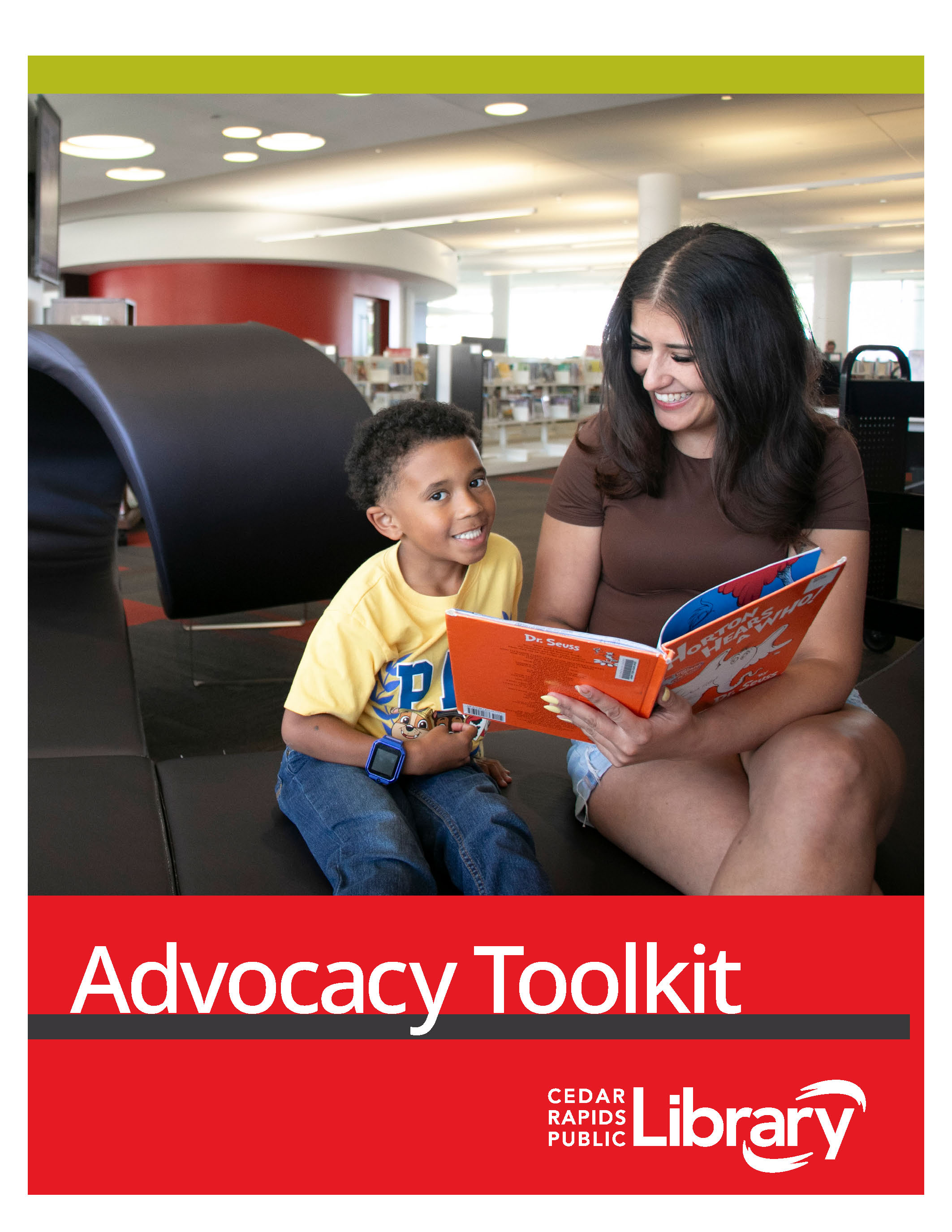
The Cedar Rapids Public Library is grateful for the support of our community. The purpose of this page is to outline resources to promote the importance and value of the Cedar Rapids Public Library. These tools have been compiled to make it as easy as possible to share your support for the library with your friends, family, and community.
Advocacy helps to:
- Inform public library users and the community about library services and their value
- Demonstrate how public library services improve the lives of people in the community
- Ensure libraries have resources to continue offering these important services
- Secure a place at the table for library leaders where important funding and policy decisions are made
Why is Advocacy Important?
Library advocacy is important because it ensures we continue to have the means necessary to serve as a vital community resource supporting all community members. Regular and consistent advocacy with stakeholders means there is a greater chance of being top of mind when important decisions are being made.
We hope this toolkit will offer you the resources needed to advocate for the Cedar Rapids Public Library. Some examples of the messages we hope you will share:
- “The Cedar Rapids Public Library is a vital community hub that fosters lifelong learning, promotes literacy, and provides equal access to information for all residents.”
- “The library offers free resources, programs, and services that support education, professional development, and personal growth, contributing to a thriving community.”
- “Investing in the Cedar Rapids Public Library is an investment in our community’s future, as it enhances quality of life, promotes economic development, and strengthens social cohesion.”

Share Your Library Story
The impact of a public library can best be measured by the impact on our community. This is where you come in!
Tell us a story about how the library has impacted your life or the lives of those around you. Share meaningful interactions or moments, or tell us about your experience with a library staff member.
By submitting this form, you give the Cedar Rapids Public Library permission to publish your story. When we share stories, we typically display only your first name and last initial. Not all submissions are published.

Freedom to Read Timeline
The freedom to read is intertwined with U.S. history, enshrined in the First Amendment and founding ideals of this country.
However, book challenges have also been a recurring feature of American history. Find a timeline of the history of the freedom to read in Cedar Rapids, Iowa, and beyond at the link below.