
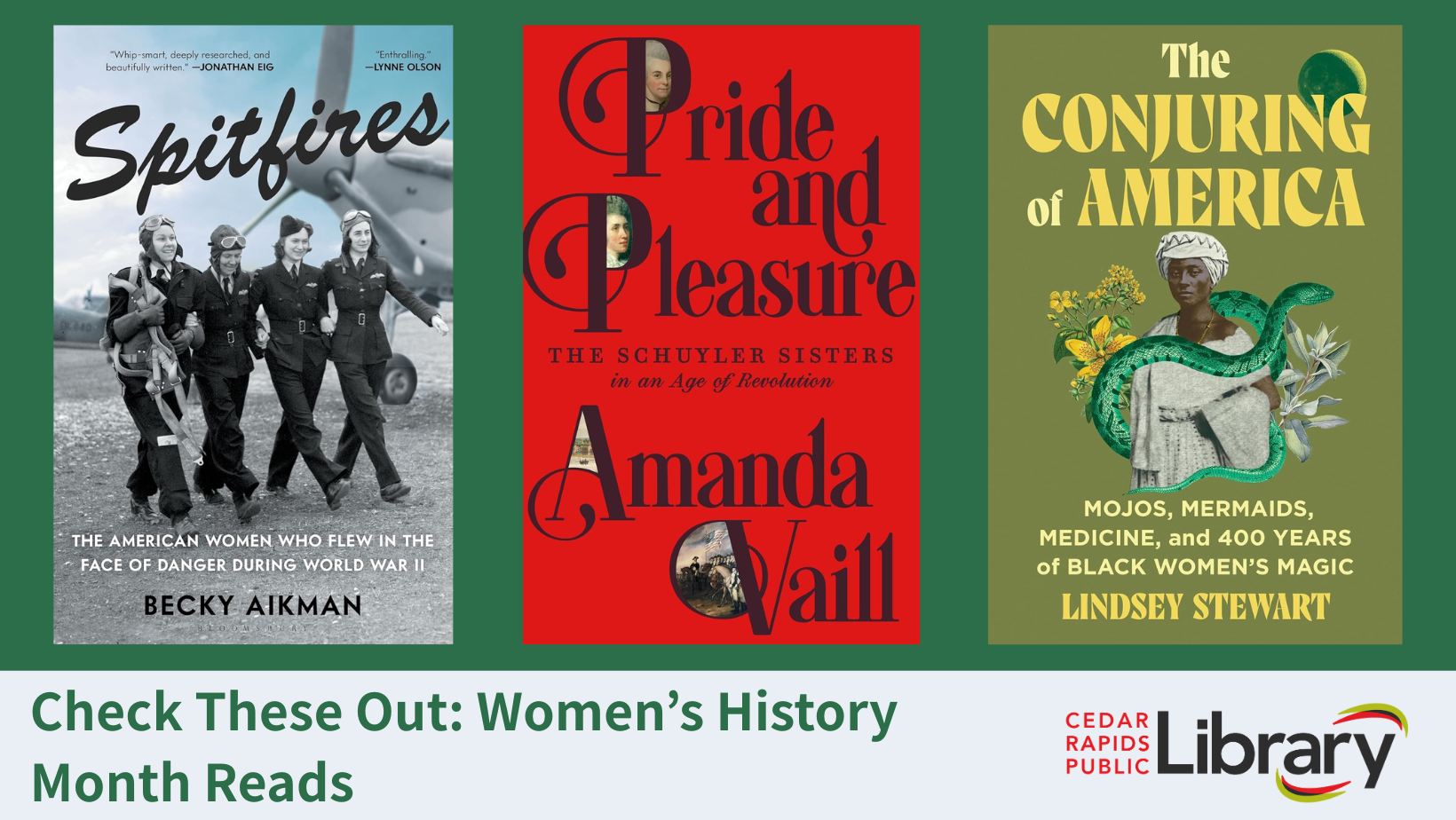
March 9, 2026 – In honor of Women's History Month, here are ten recently published books that dive deep into the lives of women who changed American history. These nonfiction accounts tell stories from the country's founding, the Civil War, World War II, and beyond, featuring both prominent trailblazers and women who made history from behind the scenes.
"The Improbable Victoria Woodhull: Suffrage, Free Love, and the First Woman to Run for President" by Eden Collinsworth (2025)
Born dirt-poor in an obscure Ohio settlement, Victoria Woodhull was the daughter of an illiterate mother entranced by the fad of Mesmerism – a therapeutic pseudoscience – and a swindler father whose cons exploited his two daughters. It was through her mother, though, that Woodhull familiarized herself with the supernatural realm, earning a degree of fame as a clairvoyant and her first taste of financial success. Woodhull's life would continue to turn on its axis and then turn again. Despite a deeply troubled first marriage at the age of fourteen, countless attempts by the press to discredit her, and a wrongful jail sentence, Woodhull thrived through sheer determination and the strength of her bond with her sister Tennie.
She co-founded a successful stock brokerage on Wall Street, launched a newspaper, and became the first woman to run for president. Hers was a rags to riches story that saw her cross paths with Karl Marx, Henry Ward Beecher, and Frederick Douglass. In an era when women's rights were circumscribed, and the idea of leaving a marriage was taboo, she broke the rules to carve out a path of her own.
"We the Women: The Hidden Heroes Who Shaped America" by Norah O'Donnell (2026)
"We the Women" presents a fresh look at American history through the eyes of women, introducing us to inspiring patriots who demanded that the country live up to the promises made 250 years ago in the Declaration of Independence: “that all men are created equal, that they are endowed by their Creator with certain unalienable Rights, that among these are Life, Liberty and the pursuit of Happiness.” Since the signing of that document, the pressing question from women has been: Why don’t those unalienable rights apply to us?
Through extensive research and interviews, as well as historical documents and old photos, O’Donnell curates a compelling portrait of these fierce fighters for freedom. From Mary Katherine Goddard, who printed the first signed Declaration of Independence, to the Forten family women, who were active in the abolition and suffrage movements and were considered the “Black Founders” of Philadelphia, to the first women who served in the armed forces even before they had the right to vote, O’Donnell brings these extraordinary women together for the first time, and in doing so writes the American story anew.
"The Conjuring of America: Mojos, Mermaids, Medicine, and 400 years of Black Women's Magic" by Lindsey Stewart (2025)
Emerging first on plantations in the American South, enslaved conjure women used their magic to treat illnesses. These women combined their ancestral spiritual beliefs from West Africa with local herbal rituals and therapeutic remedies to create conjure, forging a secret well of health and power hidden to their oppressors and many of the modern-day staples we still enjoy.
In "The Conjuring of America," Black feminist philosopher Lindsey Stewart exposes this vital contour of American history. In the face of slavery, Negro Mammies fashioned a legacy of magic that begat herbal experts, fearsome water bearers, and powerful mojos – roles and traditions that for centuries have been passed down to respond to Black struggles in real time. And when Jim Crow was born, Granny Midwives and textile weavers leveled their techniques to protect civil and reproductive rights, while Candy Ladies fed a generation of freedom crusaders.
"Spitfires: The American Women Who Flew in the Face of Danger During World War II" by Becky Aikman (2025)
They were crop dusters and debutantes, college girls and performers in flying circuses – all of them trained as pilots. Because they were women, they were denied the opportunity to fly for their country when the United States entered the Second World War. But Great Britain, desperately fighting for survival, would let anyone – even Americans, even women – transport warplanes. Thus, twenty-five daring young aviators bolted for England in 1942, becoming the first American women to command military aircraft.
In a faraway land, these “spitfires” lived like women decades ahead of their time. Risking their lives in one of the deadliest jobs of the war, they ferried new, barely tested fighters and bombers to air bases and returned shot-up wrecks for repair, never knowing what might go wrong until they were high in the sky. Many ferry pilots died in crashes or made spectacular saves. It was exciting, often terrifying work. The pilots broke new ground off duty as well, shocking their hosts with thoroughly modern behavior.
"Pride and Pleasure: The Schuyler Sisters in an Age of Revolution" by Amanda Vaill (2025)
If it hadn’t been for the Revolutionary War, things might have been very different for the two women Alexander Hamilton came to describe as his “dear brunettes.” Angelica and Elizabeth Schuyler, daughters of colonial Hudson Valley aristocracy, would have followed their family’s expectations, making dynastic marriages and supervising substantial households – but they didn’t. Instead, they became embroiled in the turmoil of America’s insurrection against Great Britain, and rebelled themselves, in ways as different as each sister was from the other, against the destiny mapped out for them.
Glamorous Angelica, who sought fulfillment in attachments to powerful men, eloped with a war profiteer and led a luxurious life, charming Benjamin Franklin, Thomas Jefferson, and the Prince of Wales. Eliza, too candid for flirtation and uninterested in influence or intrigue, married a penniless outsider, Alexander Hamilton, and devoted herself to his career; but after his appointment as America’s first treasury secretary, she was challenged by the public and private controversies that plagued him – not least of all the attraction that grew between him and her adored sister. When tragedy followed, everything changed for both women: one was deprived of her animating spirit, while the other gained a new, self-determined life.
"Winning the Earthquake: How Jeannette Rankin Defied all Odds to Become the First Woman in Congress" by Lorissa Rinehart (2025)
Born on a Montana ranch in 1880, Jeannette Rankin knew how to ride a horse, make a fire, and read the sky for weather. But, most of all, she knew how to talk to people and unite them around a shared vision for America. It was this rare skill that led her to become the first woman ever elected to the U.S. House of Representatives. As her first act, Rankin put forth the legislation that would become the Nineteenth Amendment. During her two terms, beginning in 1917 and in 1941, she introduced and lobbied for legislation strengthening women's rights, protecting workers, supporting democratic electoral reform, and promoting peace through disarmament.
As Congress's fiercest pacifist, she used her vote to oppose the declaration of war against the German Empire in 1917 and the Japanese Empire in 1941, holding fast to her belief that "you can no more win a war than you can win an earthquake." A suffragist, peace activist, workers' rights advocate, and champion of democratic reform who ran as a Republican, Rankin remained ever faithful to her beliefs, no matter the price she had to pay personally.
"Lincoln's Lady Spymaster: The Untold Story of the Abolitionist Southern Belle Who Helped Win the Civil War" by Gerri Willis (2025)
Wealthy Southern belle Elizabeth Van Lew had it all. Money, charm, wit – the most elegant mansion in Richmond. So why risk everything to become a Union spy? The answer was simple: freedom. Right in the heart of the Confederate capital, Elizabeth played the society lady while building a secret espionage network – the Richmond spy ring – of slaves, Unionists, and prisoners of war.
It would cost her almost everything. Flouting society’s expectations for women in the Civil War, Elizabeth infiltrated prisons and defied public opinion. From grave robbery to a bold voyage across enemy lines, Elizabeth’s escapades only grew more daring. But it paid off. By the war’s end, she had agents in both the Confederate War Department and the Richmond White House, and her couriers provided General Ulysses S. Grant with crucial, daily intelligence for his final assault.
"Propaganda Girls: The Secret War of the Women in the OSS" by Lisa Rogak (2025)
Betty MacDonald was a 28-year-old reporter from Hawaii. Zuzka Lauwers grew up in a tiny Czechoslovakian village and knew five languages by the time she was 21. Jane Smith-Hutton was the wife of a naval attaché living in Tokyo. Marlene Dietrich, the German-American actress and singer, was of course one of the biggest stars of the 20th century. These four women, each fascinating in her own right, together contributed to one of the most covert and successful military campaigns in WWII.
As members of the OSS, their task was to create a secret brand of propaganda produced with the sole aim to break the morale of Axis soldiers. Working in the European theater, across enemy lines in occupied China, and in Washington, D.C., Betty, Zuzka, Jane, and Marlene forged letters and "official" military orders, wrote and produced entire newspapers, scripted radio broadcasts and songs, and even developed rumors for undercover spies and double agents to spread to the enemy. And outside of a small group of spies, no one knew they existed.
"Starry and Restless: Three Women Who Changed Work, Writing, and the World" by Julia Cooke (2026)
She hid on a Red Cross boat to reach Omaha Beach on D-Day. She walked the abandoned streets of Hong Kong to take food to her daughter’s father, a prisoner of war. She fought off the advances of overzealous Yugoslavian diplomats, found overlooked details of world history in a dentist’s kitchen in Sarajevo. She traveled alone to Mexico. She traveled alone to Congo. She traveled alone to the American South. She married Hemingway. She married a Chinese poet-playboy-publisher, then married a British war hero. She fell in love with H. G. Wells. She gave birth and raised a child on her own. She landed on the front page of the newspaper. She wrote for the great magazines of her time – Vogue, The New Yorker, Harper’s Bazaar. She wrote a play. She wrote a memoir. She wrote a genre-breaking travel narrative. She wrote bestsellers. She wrote and wrote and wrote. She changed the very way we think about writing and the way journalists craft stories – which sources are viable, which details are important – and the way women move and work in the world.
She was Martha Gellhorn. She was Emily “Mickey” Hahn. She was Rebecca West. Each woman was starry-eyed for success, for adventure, and helped ensure that other starry and restless women could make unforgettable lives for themselves. They fought for their lives and their work. They were praised and criticized for it all.
"Troublemaker: The Fierce, Unruly Life of Jessica Mitford" by Carla Kaplan (2025)
This biography of Jessica Mitford, fifth of the six famous Mitford Girls, tells the wild and unlikely story of a British aristocrat who became an American Communist, bringing her astonishing self-transformation to life with a riveting, often hilarious, account of trading wealth and status for a life of radical activism. Who could predict that a British aristocrat would so energize American antiwar and civil rights struggles that Time magazine would crown her "Queen of the Muckrakers"?
Jessica Mitford, fifth of the six famous "Mitford Girls," was brought up by an eccentric English family to marry well and reproduce her wealth and privilege, not to advocate for the less advantaged. Her five beautiful sisters have been subjects of books and movies dedicated to their naughty, glamorous lives. Jessica – known as Decca – ran away to America to forge a wilder rebel's life. As this richly researched book details, Decca broke the Mitford mold – fighting fascism in the Spanish Civil War, becoming an American Communist and pioneering witty, wildly popular journalism, including her blockbuster "The American Way of Death," placing her at the heart of social justice battles. Decca relentlessly injected laughter into her politics, encouraging the activists she influenced to do likewise. From famed baby doctor Benjamin Spock to best friend Maya Angelou, her anti-authoritarian irreverence had a profound impact on American culture.