
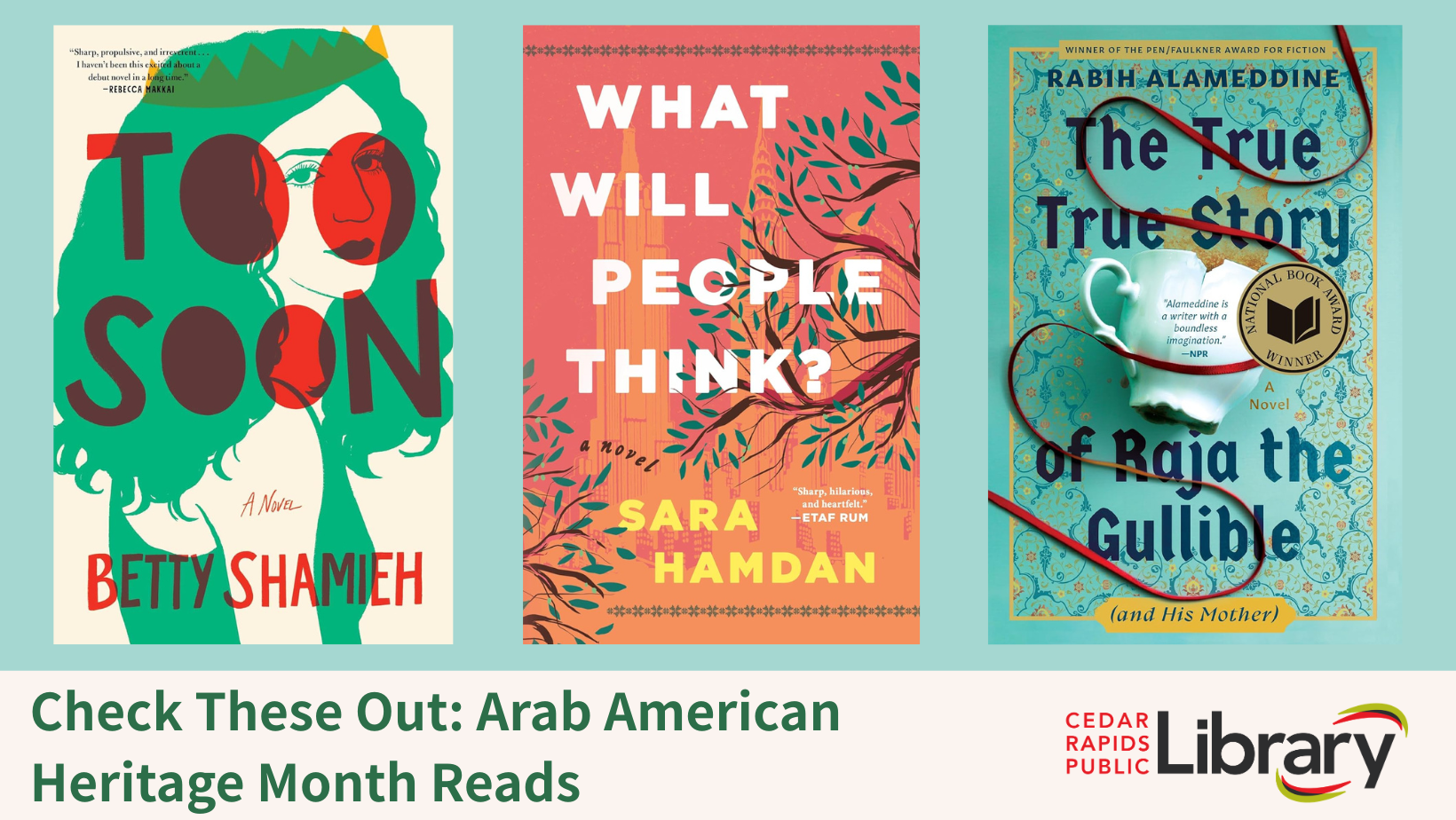
April 10, 2026 – April is Arab American Heritage Month, celebrating the culture and contributions of the people who make up the Arab world. The theme for the month this year is "Many Voices, One Community," reflecting the rich diversity of Arab American identities while affirming the shared values that unite the community. Check out these books written by and about Arab and Arab American people this month and all year.
Fiction
"What Will People Think?" by Hamdan Sara (2025)
Mia Almas has a secret. By day, she works at a respectable job as a media fact checker―a position her conservative, Arab grandparents approve of―and, by night, she takes to the stages of New York City comedy clubs. She holds herself back in a lot of ways, especially in the romance department, but being on stage lights her up and makes being a wallflower the rest of the time more bearable. That is, until Phaedra, her stylish and bold new neighbor, inspires Mia to take a few risks.
As Mia pursues a forbidden romance with her boss, her standup gets better and bolder, leading to a surprise spotlight that exposes her secret gig. Horrified and worried that her rebellious act could mean big consequences for her reserved Palestinian-American family, Mia frantically dives into damage control. But all of her efforts to pull back from the spotlight expose a family scandal from the 1940s that could change everything.
"The Sisters" by Jonas Hassen Khemiri (2025)
Meet the Mikkola sisters: Ina, Evelyn, and Anastasia. Their mother is a Tunisian carpet seller, their father a mysterious Swede who left them when they were young. Ina is tall, serious, a compulsive organizer. Evelyn is dreamy, magnetic, a smooth talker. And Anastasia is moody, chaotic, a shape-shifting presence, quick to anger. Ina meets her future husband when she's dragged to a New Year's rave by her sisters, only to suffer the ultimate betrayal. Evelyn drifts through life before embarking on a wild career as an actress. And Anastasia runs off to Tunisia, where she falls in love with a woman who, years later, will transform her life.
Following the sisters from afar is Jonas, the son of a Swedish mother and a Tunisian father. Over the course of three decades, his life intersects with the sisters, from a chance encounter in Tunis to the scene of a fighter jet crash in Stockholm. When Evelyn disappears on a trip to New York, Jonas manages to track her down – and helps her to break the curse that has been looming over the Mikkolas for decades. In the process, a shocking revelation changes everything about who they think they are.
"The Coin" by Yasmin Zaher (2024)
"The Coin’s" narrator is a wealthy Palestinian woman with impeccable style and meticulous hygiene. And yet the ideal self, the ideal life, remains just out of reach: her inheritance is inaccessible, her homeland exists only in her memory, and her attempt to thrive in America seems doomed from the start. In New York, she strives to put down roots. She teaches at a school for underprivileged boys, where her eccentric methods cross boundaries. She befriends a homeless swindler, and the two participate in an intercontinental scheme reselling Birkin bags.
But America is stifling her – her willfulness, her sexuality, her principles. In an attempt to regain control, she becomes preoccupied with purity, cleanliness, and self-image, all while drawing her students into her obsessions. In an unforgettable denouement, her childhood memories converge with her material and existential statelessness, and the narrator unravels spectacularly.
"The True True Story of Raja the Gullible (and his Mother)" by Rabih Alameddine (2025)
In this 2025 National Book Award winner, sixty-three-year-old Raja and his mother live side by side in a tiny Beirut apartment. A beloved high school philosophy teacher and "the neighborhood homosexual," Raja relishes books, meditative walks, order, and solitude. Zalfa, his octogenarian mother, views her son's desire for privacy as a personal affront. She demands to know every detail of Raja's work life and love life, boundaries be damned.
When Raja receives an invite to an all-expenses-paid writing residency in America, the timing couldn't be better. It arrives on the heels of a series of personal and national disasters that have left Raja itching for peace and quiet away from his mother and the heartache of Lebanon. But what at first seems a stroke of good fortune soon leads Raja to recount and relive the very disasters and past betrayals he wishes to forget. Told in Raja's irresistible and wickedly funny voice, the novel dances across six decades to tell the unforgettable story of a singular life and its absurdities – a tale of mistakes, self-discovery, trauma, and maybe even forgiveness.
"Too Soon" by Betty Shamieh (2025)
Thirty-five-year-old Arabella, a New York theatre director whose dating and career prospects are drying up, is offered an opportunity to direct a risqué cross-dressing interpretation of a Shakespeare classic – that might garner international attention – in the West Bank. Her mother, Naya, and grandmother, Zoya, hatch a plot to match her with Aziz, a Palestinian American doctor volunteering in Gaza. Arabella agrees to meet Aziz, since her growing feelings for Yoav, a celebrated Israeli American theatre designer, seem destined for disaster.
This dramatic saga follows one family’s epic journey fleeing war-torn Jaffa in 1948, chasing the American Dream in Detroit and San Francisco in the sixties and seventies, hustling in the New York theatre scene post-9/11, and daring to stage a show in Palestine in 2012. Upon learning one of them is living on borrowed time, the three women fight to live, make art, and love on their own terms.
"If an Egyptian Cannot Speak English" by Noor Naga (2022)
In the aftermath of the Arab Spring, an Egyptian American woman and a man from the village of Shobrakheit meet at a café in Cairo. He was a photographer of the revolution, but now finds himself unemployed and addicted to cocaine, living in a rooftop shack. She is a nostalgic daughter of immigrants “returning” to a country she’s never been to before, teaching English and living in a light-filled flat with balconies on all sides. They fall in love and he moves in. But soon their desire – for one another, for the selves they want to become through the other – takes a violent turn that neither of them expected.
Nonfiction
"One Day, Everyone Will Have Always Been Against This" by Omar El Akkad (2025)
In this 2025 National Book Award winner comes a powerful reckoning with what it means to live in the heart of an empire that doesn't consider you fully human. On October 25, 2023, after just three weeks of the bombardment of Gaza, novelist and journalist Omar El Akkad put out a tweet: "One day, when it's safe, when there's no personal downside to calling a thing what it is, when it's too late to hold anyone accountable, everyone will have always been against this." This tweet was viewed more than ten million times.
As an immigrant who came to the West, El Akkad believed that it promised freedom. A place of justice for all. But in the past twenty years, reporting on the War on Terror, Ferguson, climate change, Black Lives Matter protests, and more, and watching the unmitigated slaughter in Gaza, El Akkad has come to the conclusion that much of what the West promises is a lie. That there will always be entire groups of human beings it has never intended to treat as fully human – not just Arabs or Muslims or immigrants, but whoever falls outside the boundaries of privilege. "One Day, Everyone Will Have Always Been Against This" is a chronicle of that painful realization, a moral grappling with what it means, as a citizen of the U.S., as a father, to carve out some sense of possibility in a time of carnage.
"Defiance: A Memoir of Awakening, Rebellion, and Survival in Syria" by Loubna Mrie (2026)
Like any good Alawite girl, every day at school, Loubna Mrie pledged allegiance to Hafez al-Assad. When she complained about memorizing his speeches for class, she was told to shorten her tongue – without the president, her family believed, the Alawites would be persecuted by the Sunni majority, as they had been for centuries before the Assads came to power. A girl’s role was to obey, not to question. Loubna’s father, a mercurial businessman with close ties to the Assad regime, ruled over his wife and daughters with absolute authority. In their world, loyalty was survival. Curiosity was blasphemy. Dissent was betrayal.
But everything changed in 2011, when the pro-democracy uprisings of the Arab Spring reached Syria. Unable to suppress her curiosity, Loubna attended an anti-government protest. What she witnessed – the courage, the brutality, and the lies that followed – ignited something in her that would not be extinguished. She joined the resistance, risking her life by fearlessly proclaiming her Alawite heritage and, later, as a photojournalist documenting the war for Reuters and other outlets. Her defiance would come at a devastating cost: the loss of loved ones, her community, and ultimately her country. Leaving behind everything she knew, she would have to find a new home within herself.
Cookbooks
"Madaq: Simple and Delicious Everyday Recipes with the Flavors of Morocco" by Nargisse Benkabbou (2026)
As the daughter of two Moroccan immigrants, Nargisse Benkabbou inherited a world of flavor. Despite living hundreds of miles away from their native country, her family’s table was loaded with Moroccan cuisine: rich spices, succulent meats, unforgettable stews, and savory sauces. One dish at a time, Benkabbou learned her own heritage and, ultimately, kept close to her family’s roots.
Taking its title from the Moroccan word for flavor, "Madaq" explores traditional Moroccan recipes with an American kitchen in mind. Discover the bold dishes and amazing flavors of Morocco in your own kitchen and uncover what makes this North African cuisine – shaped by Berber roots, Arabic traditions, and Mediterranean brightness – so accessible, delicious, and memorable.
"The Ramadan Kitchen: Nourishing Recipes from Fast to Feast" by Ilhan Mohamed Abdi (2026)
The holy month of Ramadan is a time for spiritual reflection, connection and renewal, and the dishes prepared during this month often become treasured traditions passed down through generations.
Drawing on flavors from East and North Africa, the Middle East and the wider Muslim diaspora, this thoughtful collection of recipes has been crafted with warmth and care for the way we cook today – incorporating dishes that have been inherited, reimagined, or newly formed. In this sumptuous cookbook, food writer Ilhan Mohamed Abdi weaves personal stories with the flavors of her Somali-Egyptian heritage, along with easy-to-make dishes influenced by Ramadan food traditions from around the world.