
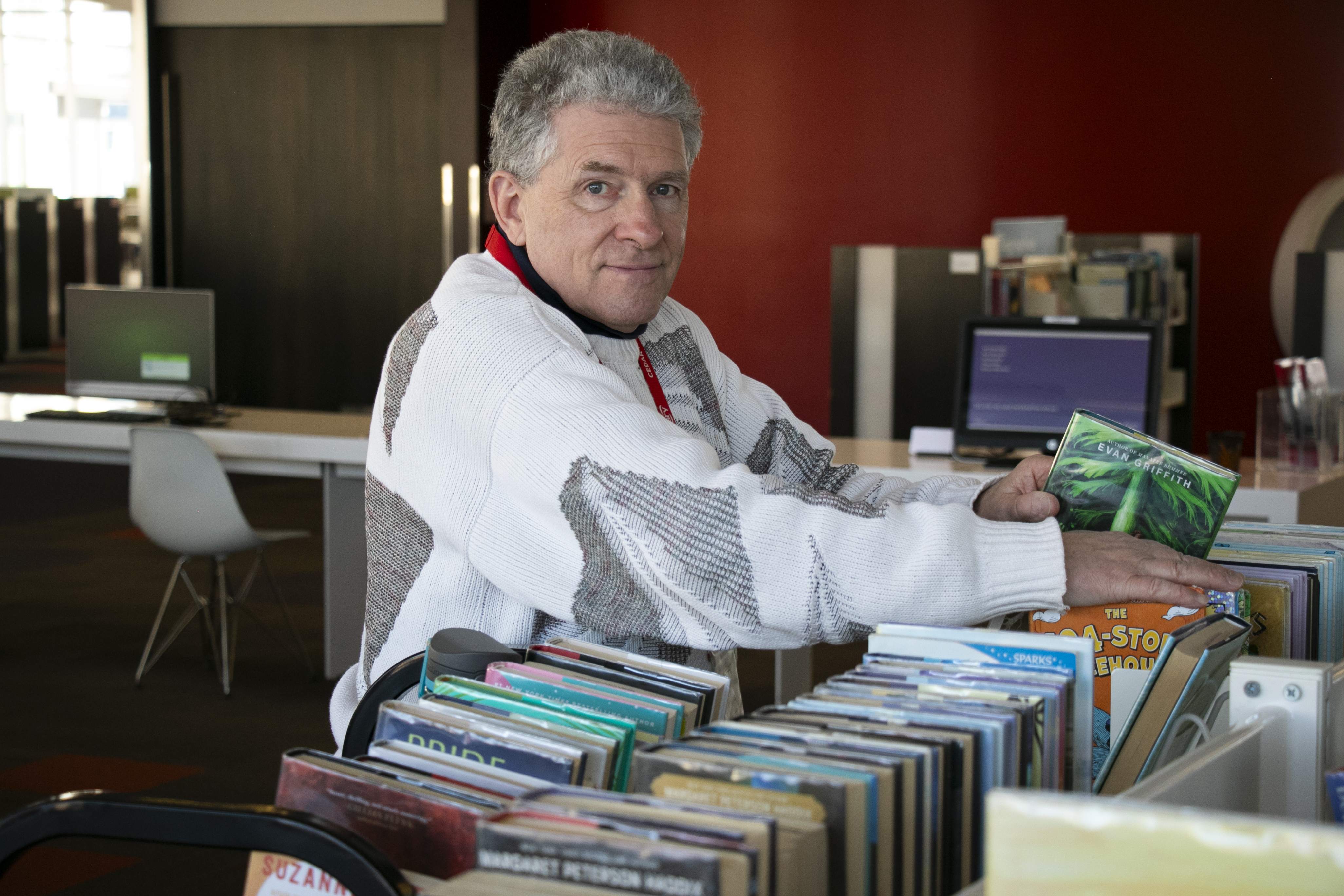
March 2, 2026 – Library staff love when new boxes of books arrive – and library patrons are often eager for the newest releases – but it takes more than unboxing those books to get them onto library shelves and into readers’ hands. We wanted to give you a behind-the-scenes look at the process.
When new books arrive at the library, our materials staff must fi rst pre-process books by fitting them with Mylar covers, the thin plastic sheets that protects books from damage and dirt. Each book is then stamped with the Cedar Rapids Public Library name and given a barcode and an RFID (radio-frequency identifi cation) tag. These are used to keep track of where a book is, either in the library building or checked out to a library patron. The library has an automated sorting machine that reads the RFID tags when people return books and checks them in as they go through the machine. The self-check machines also read these tags when people borrow books.
Finally, each book must get an electronic record for the library’s catalog. The record includes information like title, author, publication date, genre, subject headings, and sometimes a synopsis of the book. If the library has multiple copies of a book, each of their barcodes is individually attached to the catalog record – the barcode denotes what section of the library the book is in and whether that copy is on the shelf or checked out.
Once all of that is done, the book goes on the sorting machine, is checked in, and is ready to be shelved. Some books go directly to the holds shelf for someone to pick up, or, if they are destined for a different library location, are picked up by a driver who ferries books between libraries. The Cedar Rapids Public Library shares a collection between the Downtown and Ladd libraries, as well as with the Marion and Hiawatha public libraries and the Watts Medical Library at Mercy Medical Center.
Materials Manager Erin Horst estimates the Cedar Rapids Public Library purchases between 10,000 to 15,000 physical books a year, depending on budget and other factors. Those purchases include new releases and popular titles, filling requests from community members, and replacing damaged and worn books. Processing more than 10,000 books a year means the library’s materials staff is very, very busy.
“I think that sometimes people expect that when a new release comes out, it should be as fast for us to get it to them as buying a book online, but that’s not how it works,” Horst said. “In the past, we would almost always have books on release date, but that’s just not the case anymore.”
That’s partly because the process used to be much faster. Previously, most of the pre-processing work on the books was done by Baker & Taylor, a company that supplied books to libraries across the country. But in October, after more than 200 years in business, Baker & Taylor suddenly announced they would close.
That announcement sent shock waves through the library world and led to months of disruptions for some libraries as they scrambled to find new vendors. Luckily, the Cedar Rapids Public Library was already working with some of those smaller vendors and was able to quickly shift purchasing to them. However, as every library in the country worked to do the same, those vendors sometimes struggled to keep up. As a result, some new or unexpectedly popular books don’t arrive as quickly as they used to. Book processing work has also shifted back to library staff.
“We depend on our vendors to get things to us, and they are also very overloaded,” Horst said. “We're keeping up pretty well. But it does mean we have less time to do reference work, patronfocused work, and instead we’re spending more time processing materials.”
That isn’t the only challenge the library faces when purchasing books. Though the budget has remained steady, it buys fewer titles each year.
“The costs of individual books have gone up a fair amount – $28 books are now $35 books,” Horst said. “And for some formats, like large print, those are over $40 at this point. There are also fewer and fewer titles available in large print."
Demand for ebooks and digital audiobooks also continues to rise, and those can be prohibitively expensive for the library to purchase. A digital license for an ebook or audiobook that would cost $15 for a private citizen can cost $60-$100 for a library copy – and those licenses often expire after a year or after a certain number of borrows.
Horst assured patrons that even with all these challenges, the library staff are working hard to keep the collection fresh and relevant. Sometimes holds lists might be longer than in the past, but the library is dedicated to getting as many books to as many people as possible.
“If we had the money, I would buy everything for you,” Horst said. “I would, I promise!”
OPEN+ Magazine
This article was originally published in the spring 2026 issue of the library's OPEN+ magazine.